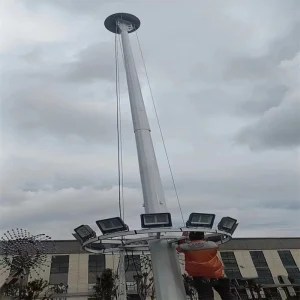
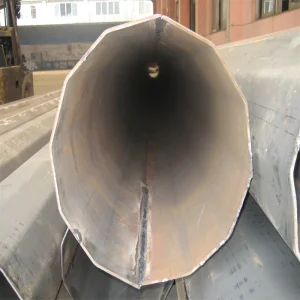
These four product families are immediately relevant to Novosibirsk buyers because they combine structural scale, export packing, photometric flexibility, and maintenance access for airport, logistics, telecom, industrial, and municipal applications. Each product keeps its original factory URL and can be engineered to project-specific wind, ice, temperature, and electrical requirements.


In modern semantic search, buyers rarely search only for a product category. They search for a duty: “30m airport high mast tower for Novosibirsk,” “IP66 LED floodlight tower for snow load,” “stadium lighting pole with lifting system,” or “factory price high mast exporter for Siberia.” The content below is organized around those real procurement intents, combining engineering, local application context, factory evidence, quality systems, and export experience.
A high mast floodlighting tower is not simply a steel pole with lamps. It is an integrated outdoor lighting system that includes the mast structure, foundation interface, luminaire platform or crown, lifting or lowering mechanism, electrical protection, surge management, access control, photometric design, and documentation. In Novosibirsk, these factors become more critical because winter temperatures, wind exposure, ice accumulation, snow clearance, logistics distance, and maintenance access all influence the total cost of ownership across a 20-year or longer service life.
Danyang Penelope Light Co., Ltd. approaches Novosibirsk and wider Siberian projects with a factory-to-project model: understand the site brief, select the right mast geometry and luminaire type, verify structural and electrical requirements, prepare export-ready packing, and support installation with drawings, load data, photometric files, and quality documents. This is how a product page becomes a practical procurement tool rather than a simple catalogue listing.
Novosibirsk is the administrative center of Novosibirsk Oblast and the largest city in Asian Russia. Its economic role stretches well beyond municipal lighting. The city and surrounding oblast connect the Trans-Siberian Railway, federal highway corridors, the Ob River system, Tolmachevo Airport, scientific and education clusters such as Akademgorodok, warehousing and distribution parks, energy service companies, construction material suppliers, and industrial facilities serving Siberia and Central Asia.
That economic geography produces a specific lighting demand profile. Airport aprons and cargo areas need high uniformity and glare control. Rail yards and intermodal terminals need robust poles that can tolerate vibration, impact risk, and continuous operation. Logistics warehouses, cold-chain facilities, and truck terminals need reliable dusk-to-dawn lighting with lower energy consumption. Mining service yards, construction plants, and utility compounds need large-area floodlighting where safe maintenance access matters as much as lumen output.
Novosibirsk also demands serious climate thinking. Winter design temperatures can be severe, snow and ice can accumulate on luminaires and platforms, and freeze-thaw cycles challenge coatings, seals, and electrical enclosures. A high mast system for this market therefore needs more than a competitive lamp price. Buyers should review low-temperature steel performance, welding quality, hot-dip galvanizing, powder coating, IP66 sealing, surge protection, driver starting behavior, and lifting-system safety.
30m airport high mast towers with LED floodlights, strict glare control, IP66 protection, and lifting systems for safe maintenance near aircraft operations.
Heavy-duty poles for loading areas, container terminals, inspection lanes, and storage tracks where vibration and wind loading are routine design considerations.
LED high mast floodlighting for truck courts, cold-chain facilities, distribution parks, and cross-dock operations with energy monitoring options.
Rugged high mast systems for equipment yards, fuel depots, utility compounds, and industrial sites requiring corrosion protection and easy spare-part planning.
18m, 20m, and 25m stadium light pole towers with lifting systems for sports fields, public plazas, parks, and event spaces.
Large-area floodlighting for loading docks, storage yards, perimeter security, and access roads, with photometric layouts matched to site geometry.
Globally, high mast floodlighting demand is being reshaped by port expansion, airport modernization, logistics real estate, sports infrastructure, industrial reshoring, and smart-city programs. Buyers increasingly compare not only pole price per metre, but also photometric performance, energy use, maintenance frequency, structural documentation, corrosion protection, and the supplier’s ability to deliver a complete export-ready package. In cold-climate and remote regions, the cost of sending a service crew to replace a failed driver or luminaire can exceed the initial hardware saving.
Global enterprises and EPC contractors usually procure high mast towers through a multi-criteria process. They ask for wind-load calculations, foundation reactions, welding standards, coating specifications, IP ratings, surge protection, photometric files, and warranty terms. Distributors and municipal buyers often add packaging, spare-parts, installation guidance, and after-sales response requirements. This is why a credible exporter should behave like an engineering partner: clarify the design inputs, document assumptions, and align the factory build with the project’s acceptance criteria.
Chinese factories have become central to global high mast supply because they combine scale, automated fabrication, broad component sourcing, and fast customization. However, the strongest suppliers distinguish themselves through traceability, testing, export packing, and communication. For Novosibirsk buyers, the ideal supplier is not simply the lowest quotation; it is the factory that can translate a Siberian site brief into a buildable, maintainable, and well-documented lighting asset.
Illustrative procurement emphasis based on common cold-climate and large-area lighting enquiry patterns; final weights depend on the specific project specification.
The commercial opportunity is clear. A single Novosibirsk logistics park, airport expansion, rail terminal, stadium renovation, or industrial yard can require dozens of high masts plus spare luminaires and control equipment. Repeat demand follows when the first installation demonstrates reliable performance, clean documentation, and responsive support. For exporters, the most valuable asset is not one transaction but a reputation for predictable engineering and delivery in difficult climates.
Chinese factory efficiency is not only about competitive pricing. It is a production system: automated cutting, bending, welding, coating, assembly, testing, and export packing working together so that custom high mast projects can move from approved drawings to shipment with fewer errors. For a Novosibirsk buyer, this efficiency matters because the project window is often short, the shipping distance is long, and site corrections are expensive. A well-organized factory reduces rework, improves consistency, and gives the buyer clearer milestones for inspection and delivery.
Danyang Penelope Light Co., Ltd. combines large-scale equipment with lighting-specific production lines. CNC bending, longitudinal shearing, submerged arc welding, electrostatic powder coating, fluorocarbon paint spraying, and laser cutting are not isolated capabilities; they support the complete chain from pole fabrication to luminaire integration. This is especially relevant for high mast floodlighting towers, where structural straightness, weld quality, coating adhesion, platform alignment, and electrical integration directly affect safety and serviceability.
Danyang Penelope Light Co., Ltd. is a leading high-tech lighting enterprise. Founded in 2003, our company has developed over 20 years into a modern, innovative manufacturer of high-quality lighting solutions with a strong reputation in both domestic and international markets.
Our factory is equipped with advanced large-scale automated equipment, including CNC bending machines, high-speed longitudinal shear machines, automatic submerged arc welding systems, gas welding stations, electrostatic powder coating facilities, specialized fluorocarbon paint spraying rooms, and precision laser cutting machines. This comprehensive infrastructure enables us to maintain high efficiency, consistent quality, and rapid production cycles.
We operate seven dedicated production lines, covering all aspects of lighting manufacturing:
Danyang Penelope Light Co., Ltd. is recognized as a national high-tech enterprise with first-class urban road lighting installation qualifications and second-class lighting design qualifications. The company has been honored as a “Contract-Abiding and Trustworthy Enterprise” and maintains a continuous “AAA” credit rating. We have successfully passed ISO9001:2000 quality management system and ISO14001 environmental management system certifications, as well as national CCC and CQC product certifications, National Lamp Test Reports, and EU CE safety certifications, reflecting our commitment to excellence and international standards.
We firmly adhere to the principles of sustainable development, guided by innovative design, centered on high-quality products, and grounded in reliable craftsmanship. Our professional R&D team focuses on avant-garde product development, ensuring our design, innovation, and manufacturing capabilities are consistently at the forefront of the global lighting industry. With continuous investment in new technology, we are able to provide intelligent, energy-efficient, and environmentally friendly lighting solutions that meet the evolving demands of urban infrastructure and modern architectural projects.
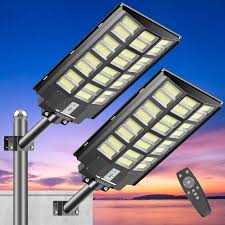
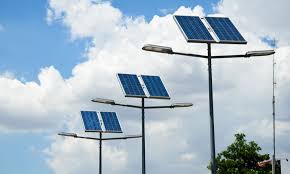
Our diverse product range includes solar street lights, LED street lights, high-mast lights, lighting poles, and complete solar power systems. With a commitment to excellence, reliability, and innovation, our products are exported to numerous countries worldwide, supporting urban and rural lighting projects, commercial and public spaces, landscapes, and infrastructure projects.
At Danyang Penelope Light Co., Ltd., we strive to illuminate the world with sustainable, high-quality, and technologically advanced lighting solutions, contributing to smarter, greener, and safer cities for the future.
For Novosibirsk projects, this factory structure supports several practical advantages: faster quotation engineering, flexible pole height and shape selection, coordinated luminaire sourcing, consistent coating and welding quality, and export packing designed for long-distance rail or road transport. Buyers can request photometric layouts, structural drawings, load data, finishing specifications, and inspection records before shipment, reducing the risk of site surprises.
Engineering a high mast system for Novosibirsk starts with the site, not the catalogue. The same 30m tower may require different steel thickness, coating systems, foundation reactions, luminaire schedules, and lifting arrangements depending on whether it serves an airport apron, a rail yard, a warehouse truck court, or a public stadium. The most reliable procurement path is to define the lighting task, then match the mast and luminaire configuration to that task.
For airport and cargo applications, uniformity and glare control are critical. For rail and logistics terminals, vertical illuminance, impact protection, and maintenance access often dominate. For stadium and civic spaces, colour rendering, spectator comfort, and lifting-system safety become central. For industrial yards and mining service areas, corrosion protection, spare-part planning, and robust electrical protection are essential. In all cases, the tower must be treated as part of a broader electrical and civil system, including earthing, cable entry, foundation design, and lightning protection where specified.
LED floodlights continue to replace sodium and metal halide systems, reducing energy use and enabling precise optics, dimming, and lower maintenance frequency.
Buyers increasingly request remote monitoring, scheduling, fault alerts, and energy reporting for large sites where downtime and service trips are costly.
Low-temperature starting, impact-resistant enclosures, snow-shedding layouts, and material traceability are becoming standard discussion points for Siberian projects.
Modern tenders expect documented design assumptions for wind loading, ice accumulation, foundation reactions, and mast stability under regional conditions.
Lifting and lowering systems, safe platforms, and clear service procedures are valued because a single maintenance visit can outweigh component price differences.
Hot-dip galvanizing, powder coating, and combined coating systems protect investments against snow, ice, road salt, industrial emissions, and freeze-thaw cycles.
Knocked-down or modular packing can reduce shipping friction, but it must be engineered so that site assembly, alignment, and coating repair remain practical.
Photometric files, inspection records, material certificates, packing lists, and compliance documents increasingly influence supplier selection for EPC projects.
The strongest high mast enquiries are specific. They define the lighting task, site conditions, electrical supply, control strategy, installation constraints, and acceptance documents. When those inputs are missing, a reputable factory should ask targeted questions rather than quote a generic pole. The matrix below summarizes the main decision areas for Novosibirsk and similar cold-climate projects.
A practical export workflow for Novosibirsk typically moves through these stages: inquiry and site brief → structural and photometric review → proposal and drawings → approval → production → in-process inspection → trial assembly where required → export packing → rail or road logistics → installation support → final documentation. Clear stage gates reduce misunderstandings and make it easier for EPC contractors, distributors, and municipal buyers to compare proposals on a like-for-like basis.
A high mast floodlighting tower is a tall lighting structure, often 18m to 30m or higher, that supports multiple floodlights for large-area illumination. It is used in Novosibirsk for airport aprons, rail terminals, logistics parks, industrial yards, stadiums, river ports, public plazas, and highway interchanges where conventional poles cannot deliver uniform light coverage or safe maintenance access.
Yes. Cold-climate engineering should address steel toughness, weld design, coating performance, luminaire sealing, driver starting behavior, surge protection, and snow or ice accumulation. Buyers should provide site temperature assumptions, wind and ice requirements, foundation data, and any local design code requirements so the factory can prepare appropriate drawings and calculations.
LED is usually preferred for new projects because it offers high luminous efficacy, precise optics, dimming capability, and lower maintenance. Sodium and metal halide options can still be relevant for retrofits, spare-part compatibility, or projects with existing electrical infrastructure. The best choice depends on photometric targets, energy cost, control strategy, maintenance access, and budget.
Common heights include 12m, 18m, 20m, 25m, and 30m. Airport, stadium, port, and large logistics applications often use taller towers, while commercial yards, access areas, and smaller industrial sites may use 4m to 12m configurations. The final height should be based on area size, obstruction height, glare control, mounting geometry, and maintenance method.
Danyang Penelope Light Co., Ltd. maintains ISO9001:2000 and ISO14001 management system certifications, CCC and CQC product certifications, National Lamp Test Reports, and EU CE safety certifications. Project-specific documentation can include drawings, photometric layouts, packing lists, inspection records, and other agreed quality documents.
MOQ and lead time depend on tower height, quantity, luminaire type, lifting system, coating requirements, and inspection scope. Small retrofit orders and large project orders may follow different production plans. Shipping can be arranged by rail, road, or multimodal transport through appropriate border crossings; the final route should be confirmed with the freight forwarder and the project schedule.
Yes. High mast towers can be supplied with manual or automatic lifting and lowering systems, crown platforms, safety components, and operation guidance. Installation support may include foundation interface drawings, anchor-bolt layouts, assembly instructions, and remote technical clarification. Site installation should be performed by qualified contractors according to local regulations.
Send the site location, required tower height, lighting area dimensions, lux or uniformity targets, luminaire preference, quantity, wind and snow assumptions, foundation information, electrical supply, control requirements, and delivery schedule. Clear inputs allow the factory to propose a suitable mast, photometric layout, lifting system, coating specification, and export packing plan.
These additional configurations cover mobile searchlight towers, sodium and metal halide options, round-shape masts, 7m to 30m poles, and stadium lighting towers with lifting systems. They can be adapted for Novosibirsk logistics, municipal, industrial, sports, and emergency applications while preserving the original product URLs for easy specification.

Share your tower height, lighting area, lux target, wind and snow assumptions, luminaire preference, quantity, and delivery schedule. Our team can prepare a factory-direct proposal with product selection, photometric layout, structural coordination, export packing, and documentation planning for Novosibirsk and wider Siberian projects.
Send Inquiry Now Penelope Light