Why Use Hot Dip Galvanized Outdoor Lighting Poles?

Time:2026-09-19 Author:Aria
0%

Why use hot-dip galvanizing for outdoor lighting poles? The answer begins with exposure. Lighting poles face rain, road salt, humidity, soil contact, and constant temperature changes. Bare steel can develop rust around base plates, welds, and drainage points. Hot-dip galvanizing immerses fabricated steel in molten zinc, creating a metallurgically bonded coating that protects both visibly and sacrificially.

The NACE IMPACT study estimated global corrosion costs at approximately US$2.5 trillion annually, equal to 3.4% of global GDP. That figure explains why corrosion prevention deserves attention during design, not after failure. The American Galvanizers Association reports that galvanized coatings can provide more than 70 years of maintenance-free protection in some rural environments. Industrial and marine conditions usually shorten that service life. Site assessment still matters.

Gregory Zhang, Ph.D., a galvanizing-industry technical expert, explains, “Hot-dip galvanizing provides steel with a durable, abrasion-resistant coating that protects it from corrosion.” This durability is practical on installation sites. A galvanized pole can tolerate handling, transport, and minor surface impacts better than many painted systems. Its zinc layer also protects exposed steel around small scratches.

No coating is magic. Poor drainage can trap water, and unsuitable soil conditions can accelerate zinc consumption. Designers should follow ISO 14713-2 guidance, specify vent and drain holes, and avoid details that create hidden moisture pockets. The Environmental Product Declaration approach also encourages life-cycle thinking, rather than judging cost by purchase price alone. For municipalities and facility owners, hot-dip galvanizing is not merely a finish. It is a risk-reduction decision, although every project still needs honest environmental review.
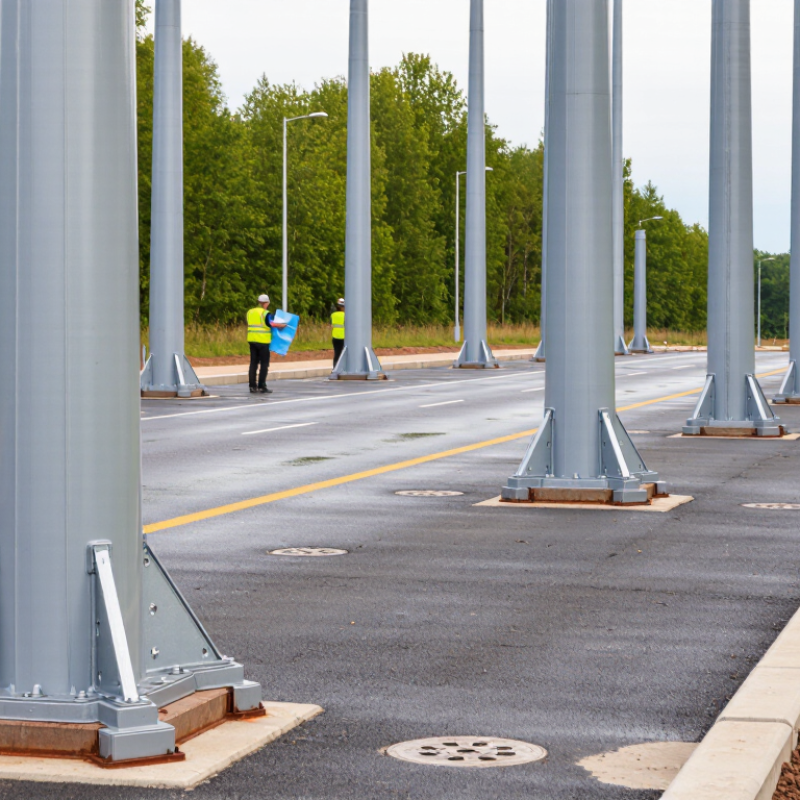
Why Use Hot Dip Galvanized Outdoor Lighting Poles?

What Are Hot Dip Galvanized Outdoor Lighting Poles?

What Are Hot Dip Galvanized Outdoor Lighting Poles?

Hot dip galvanized outdoor lighting poles are steel structures protected with a bonded zinc coating. During production, cleaned steel is immersed in molten zinc at about 450°C. The zinc reacts with the steel surface, forming tightly attached alloy layers and a protective outer layer. This differs from paint, which mainly creates a surface barrier.

The coating protects the pole in two ways. It shields steel from water and oxygen, then provides sacrificial protection if small scratches appear. The American Galvanizers Association’s Time to First Maintenance data indicates service before major maintenance can exceed 70 years in rural exposure. Suburban conditions may provide roughly 40 years. These figures are estimates, not promises. Salt spray, standing water, soil contact, and poor drainage can shorten performance.

Look closely at a galvanized pole. Its surface may appear silver, matte, or slightly uneven. That visual variation is normal. Engineers should still check coating thickness and drainage holes after fabrication.

ISO 1461 and ASTM A123 provide widely used requirements for hot-dip galvanized coatings. Field experience shows that design details matter as much as the zinc layer. A trapped pocket can collect moisture. A damaged cut edge needs proper inspection. Even durable systems deserve maintenance.

How Does Hot Dip Galvanizing Protect Lighting Poles?

Why Use Hot Dip Galvanized Outdoor Lighting Poles?

How Does Hot Dip Galvanizing Protect Lighting Poles?

Hot dip galvanizing protects lighting poles through a metallurgical bond between steel and zinc. During immersion, molten zinc reacts with cleaned steel and forms durable alloy layers. A tough outer zinc layer then blocks water, oxygen, and salts from reaching the steel. The American Galvanizers Association explains that zinc also provides sacrificial protection. It corrodes preferentially when exposed steel appears at scratches or cut edges. The mechanism is practical.

ISO 1461 specifies coating requirements for galvanized steelwork. For steel thicker than 6 millimeters, the standard requires an average coating thickness of at least 85 micrometers. Local measurements should not fall below 70 micrometers. Atmospheric corrosion data from the International Zinc Association shows zinc loss varies by environment. Typical rates range from about 0.1 micrometers per year in rural conditions to over 4 micrometers in severe marine or industrial exposure. This difference matters near coastlines.

A pole with good drainage and sealed electrical openings usually performs better. Fabricators must also provide proper vent and drain holes. Otherwise, trapped chemicals can create bare areas during processing. That risk is easy to overlook. Galvanizing is not magic. Poor weld cleaning, sharp crevices, or damaged handling can reduce service life. Field inspections should check the base, flange, and lower shaft, where standing water and road salt often collect. When design, fabrication, and coating quality work together, zinc offers measurable protection without relying on frequent repainting.

What Are the Main Benefits for Outdoor Lighting Applications?

Why Use Hot Dip Galvanized Outdoor Lighting Poles?

Hot dip galvanized outdoor lighting poles offer durable protection in demanding environments. During galvanizing, steel is immersed in molten zinc, creating bonded protective layers around the surface. This coating helps shield poles from rain, humidity, road salt, and industrial moisture. It also provides sacrificial protection when minor scratches expose the steel. That matters near parking areas, highways, sports grounds, and coastal walkways.

The main benefit is dependable service with fewer coating repairs. A properly galvanized pole can remain functional for many years, depending on local exposure and coating thickness. Its tough surface also resists ordinary handling damage during transportation and installation. However, galvanized steel is not maintenance-free. Poor drainage, trapped moisture, or cut edges can still create weak points. Design quality matters. So does installation.

Tips: Check the environment before selecting a coating specification. Coastal air may require extra attention. Keep water from collecting inside pole sections. Inspect welds, bolts, and damaged areas after installation. A small mark is easier to address early. Field inspections often reveal this simple truth: protection works best when the pole, foundation, fasteners, and drainage details are planned together. Galvanizing can reduce lifecycle effort, but it cannot correct poor engineering.

Where Are These Lighting Poles Commonly Used?

Why Use Hot Dip Galvanized Outdoor Lighting Poles?

Where Are These Lighting Poles Commonly Used?

Hot dip galvanized lighting poles are common wherever fixtures face rain, salt, soil moisture, or road spray. Typical locations include public streets, highways, parking areas, school campuses, parks, sports grounds, and residential developments. Ports and coastal promenades also use them, although severe marine exposure demands careful coating specifications and inspection.

The International Energy Agency reported that lighting consumed about 15% of global electricity in 2022. This makes reliable outdoor lighting infrastructure increasingly important. Galvanized steel poles support roadway luminaires, pedestrian lamps, security lights, and large-area floodlights. Their zinc coating protects the steel through barrier and sacrificial action. Small scratches may still receive protection.

The American Galvanizers Association’s corrosion data indicates potential coating service life exceeding 50 years in rural or suburban conditions. In severe marine environments, expected life can fall to roughly 20–25 years. Location changes everything. A pole beside a quiet park is not exposed like one beside a salted highway.

Field inspections often find problems around the base, bolt connections, and drainage points. Galvanizing helps, but it does not replace sound design. Designers should consider wind loading, soil conditions, access for maintenance, and local corrosion severity. A thicker coating is not always the complete answer. That assumption deserves caution.

How Should Hot Dip Galvanized Lighting Poles Be Maintained?

Hot dip galvanized outdoor lighting poles resist rain, humidity, and road salt through a durable zinc coating. Their protection is practical, but it is not maintenance-free. Regular care helps prevent small surface problems from becoming structural concerns.

Inspect each pole at least twice a year, especially after severe storms. Look for white zinc deposits, deep scratches, rust stains, loose bolts, and water trapped near the base. White deposits can appear during early oxidation and are often harmless. However, spreading rust needs professional assessment. Wash the surface with clean water and a soft brush. Avoid abrasive pads, strong acids, and chlorine-based cleaners. Check the foundation, access door, cables, and drainage area as well. A stable pole can still have hidden electrical or anchoring problems. Maintenance plans are not always followed perfectly. Record findings with dates and clear photographs.

Tips: Clean in mild weather. Keep drainage paths open. Tighten hardware carefully. Touch up damaged areas only with compatible zinc-rich repair materials. Do not paint over dirt or active moisture. If galvanizing damage exposes steel, isolate the area and consult a qualified lighting or corrosion professional. Inspect coastal installations more often, because salt deposits accelerate corrosion. Use safe access equipment and disconnect power before electrical work. Small oversights matter.

Why Use Hot Dip Galvanized Outdoor Lighting Poles? - How Should Hot Dip Galvanized Lighting Poles Be Maintained?
Data Dimension Typical Data or Requirement Practical Benefit Recommended Maintenance Action
Corrosion Protection Method Steel components are immersed in molten zinc, creating a metallurgically bonded zinc coating on both external and internal surfaces that can be reached by the process. Protection is more comprehensive than paint applied only to visible external surfaces. Check the complete pole, base, flange, access door, and reachable internal areas for coating damage during routine inspections.
Typical Zinc Coating Thickness For structural steel, commonly specified minimum average coating thicknesses include approximately 45 μm, 70 μm, or 85 μm, depending on the steel thickness and applicable galvanizing standard. A thicker zinc coating generally provides a longer corrosion-protection period in the same environment. Review the galvanizing certificate or coating-thickness inspection report. Do not judge coating quality by appearance alone.
Atmospheric Durability Service life varies with humidity, chloride exposure, sulfur dioxide, wetness, abrasion, and local atmospheric conditions. Hot dip galvanizing is suitable for many outdoor, roadside, municipal, industrial, and coastal applications when the coating is correctly specified. Use a site-specific inspection frequency. Increase inspection attention in coastal, de-icing-salt, industrial, or continuously damp locations.
Barrier and Sacrificial Protection Zinc provides a physical barrier and can offer sacrificial protection to small exposed steel areas, provided the damaged area is limited. Minor scratches may be less critical than equivalent damage to an unprotected painted steel surface. Clean damaged areas and repair them with a suitable zinc-rich repair system in accordance with the relevant galvanizing specification.
Appearance The surface may appear bright, matte gray, or show a spangled pattern. Color variation can result from steel chemistry and cooling conditions. Normal visual variation does not necessarily indicate reduced corrosion performance. Focus inspections on red rust, deep abrasion, flaking, cracking, blocked drain holes, and coating separation rather than color uniformity alone.
Washing Frequency In clean rural or urban environments, washing may be performed approximately every 12 months. In marine, industrial, or salt-exposed areas, a 6-month interval may be appropriate. Removing salt, dust, pollutants, and bird droppings reduces the time that corrosive deposits remain on the surface. Use clean water and a mild, non-abrasive detergent. Rinse thoroughly and avoid strong acids, strong alkalis, and abrasive tools.
Routine Visual Inspection Inspect at least annually, and more frequently where there is severe corrosion exposure, impact risk, or public-safety concern. Early detection helps prevent small coating defects from developing into structural or electrical problems. Record the inspection date, location, coating condition, fastener condition, foundation condition, and corrective actions.
Base and Foundation Condition Pay particular attention to the transition zone near ground level, anchor bolts, base plates, grout, and areas where water can collect. These areas can experience persistent moisture, splash-back, salt accumulation, or crevice corrosion. Keep drainage paths clear, remove soil or debris around the base, and investigate standing water, cracked grout, loose anchors, or exposed steel.
Fasteners and Access Doors Bolts, nuts, hinges, locks, and access-door frames should remain secure, functional, and compatible with the galvanized structure. Properly maintained hardware supports structural stability and protects electrical components from unauthorized access or water entry. Check tightness, corrosion, threads, door seals, and locking components. Replace damaged hardware with compatible galvanized or corrosion-resistant parts.
Electrical and Lighting Components Inspect cables, terminals, earthing connections, fuses, drivers, luminaires, and cable-entry points according to the electrical system requirements. Galvanizing protects the steel pole but does not replace electrical testing or protection of internal electrical components. Isolate power before service. Check earthing continuity, water ingress, insulation condition, and cable glands during scheduled electrical maintenance.
Mechanical Damage Repair Cutting, drilling, welding, or severe impact can remove or damage the zinc coating and expose the underlying steel. Prompt repair limits localized corrosion and helps restore the protective system. Remove rust and contaminants, prepare the surface, and apply an approved zinc-rich repair coating. Follow the repair product and galvanizing standard instructions.
Cleaning Restrictions Do not use abrasive blasting, wire brushing, concentrated acids, strong caustic cleaners, or chloride-rich cleaning agents for routine washing. Harsh cleaning can reduce coating thickness or leave corrosive residues on the surface. Use soft brushes or cloths, clean water, and a neutral or mildly alkaline detergent, followed by complete rinsing.
Inspection Records Maintain a record of pole identification, installation date, environment, photographs, defects, coating repairs, electrical tests, and follow-up dates. Trend information helps identify recurring corrosion locations and supports planned maintenance. Use the same inspection checklist and photo angles each time so changes can be compared accurately.
Maintenance Principle Hot dip galvanized poles generally require less frequent coating maintenance than unprotected steel, but they are not maintenance-free. Regular cleaning, inspection, drainage control, and timely repair help preserve appearance, corrosion resistance, and structural reliability. Combine an annual structural inspection with periodic cleaning and electrical testing appropriate to the site environment.

FAQS

What are hot dip galvanized outdoor lighting poles?

They are steel poles coated with bonded zinc. Cleaned steel enters molten zinc at about 450°C. The coating forms alloy layers and an outer zinc layer.

How does the zinc coating protect the steel?

Zinc blocks water and oxygen from reaching the steel. It also corrodes first when scratches expose small areas. This sacrificial action is useful.

How long can galvanized lighting poles last?

Estimated service before major maintenance may exceed 70 years in rural areas. Suburban exposure may provide roughly 40 years. These are estimates, not promises.

Which environments can shorten coating life?

Salt spray, standing water, soil contact, and poor drainage can accelerate corrosion. Coastal air deserves extra attention. Conditions change the result.

What does a galvanized pole usually look like?

Its surface may look silver, matte, or slightly uneven. These differences are normally acceptable. Appearance alone cannot confirm coating quality.

What should engineers inspect after galvanizing?

They should check coating thickness, drainage holes, welds, cut edges, and electrical openings. The base and flange need close attention. Water often collects there.

Why do design details matter?

Proper vent and drain holes prevent trapped chemicals and moisture. Sharp crevices can create weak points. Galvanizing cannot repair poor engineering.

Do galvanized poles require maintenance?

They usually need fewer coating repairs, but they are not maintenance-free. Inspect scratches, bolts, welds, and standing-water areas after installation. Small damage is easier to address early.

Are galvanized poles suitable near roads and parking areas?

They can perform well near roads, parking areas, sports grounds, and walkways. Road salt and moisture still require inspection. Selection should match local exposure.

What should buyers consider before choosing them?

Review the environment, coating thickness, drainage design, fasteners, foundation, and installation method. A durable coating helps. It cannot compensate for every mistake.

Conclusion

Hot-dip galvanized outdoor lighting poles are steel poles coated with a durable layer of zinc through immersion in molten zinc. This protective coating creates a strong barrier against moisture, oxygen, salt, and other corrosive elements, while also offering sacrificial protection if the surface is scratched. Why use hot-dip galvanizing for outdoor lighting poles? The process improves service life, reduces corrosion-related repairs, lowers long-term maintenance costs, and helps poles remain safe and attractive in demanding environments.

These lighting poles are commonly used along roads, highways, parking areas, parks, sports grounds, industrial facilities, and public spaces. Their performance makes them suitable for both urban and coastal locations. Maintenance is generally simple: inspect the poles periodically for physical damage, corrosion, loose fittings, or blocked drainage points, and keep surfaces free from accumulated dirt and chemicals. Promptly repairing damaged accessories and monitoring the surrounding foundation can further extend the poles’ reliable operating life.

Aria

Aria

Aria is a dedicated marketing professional with a deep passion for innovative strategies and a keen understanding of our company's product offerings. With a wealth of experience in the industry, Aria excels at crafting engaging content that highlights the unique features and benefits of our......