Streetlights are no longer just lamps on tall poles. In China, connected systems can link LED fixtures, sensors, controllers, and management software across busy roads and quieter residential streets. The International Energy Agency has reported that lighting represents about 15% of global electricity consumption, although the figure depends on the year and accounting scope. The U.S. Department of Energy’s 2016 solid-state lighting forecast also described major potential energy savings from wider LED adoption. These figures concern lighting broadly, not IoT streetlights alone. That distinction matters.
What are the benefits of smart IoT street lighting systems? Their value can include lower electricity use, remote fault alerts, scheduled dimming, and clearer records for maintenance teams. For example, a control center may spot a failed fixture without waiting for a resident to report a dark intersection. Sensors can also adjust output when streets are quiet, subject to local safety requirements and careful commissioning. Smart controls are not magic. Poor sensor placement, weak connectivity, or outdated equipment can reduce the gains. Results vary with existing lamps, traffic patterns, energy prices, and maintenance practices. This guide examines ten practical benefits associated with smart street lighting in China, while separating documented industry findings from claims that need local verification. It also considers the less glamorous details: installation costs, system compatibility, data quality, and whether measured savings persist after deployment. Those details deserve attention.
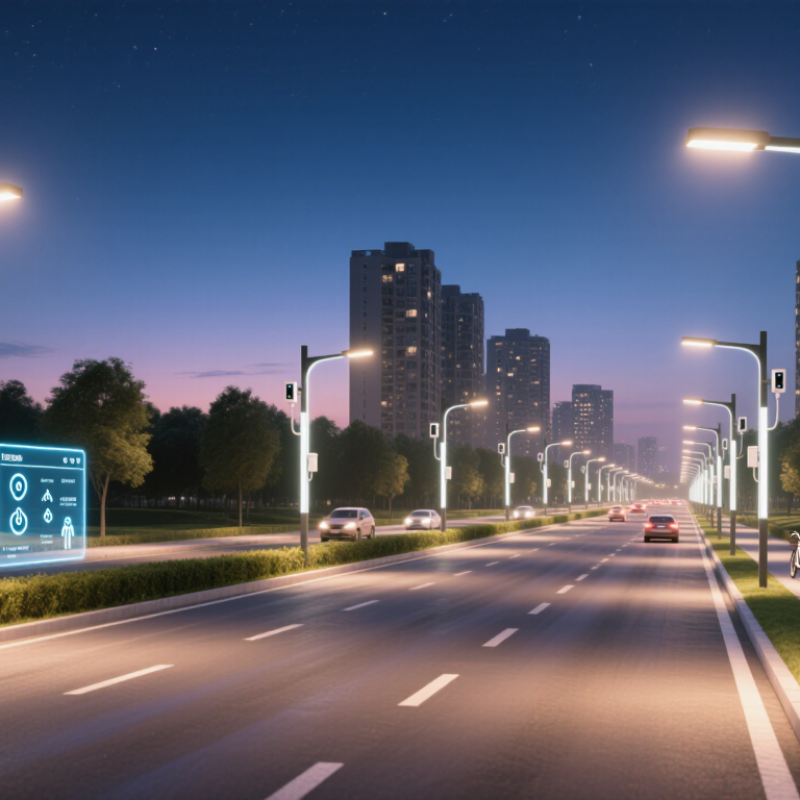
In Chinese cities, smart IoT street lighting usually connects lamp poles to a local network and a municipal control platform. Each pole can contain a controller, a communication module, and sensors for light levels or nearby movement. At dusk, the system can switch lamps on automatically. A technician may also adjust brightness remotely, rather than visiting every street.
The platform receives status reports from individual lights and groups them by road or district. On a quiet residential lane, lamps may dim late at night and brighten when a pedestrian or vehicle approaches. Busy junctions can follow different schedules. Not every city uses the same setup; road layouts, weather, and network coverage all matter. Small details matter.
When a lamp fails, its controller can send an alert with its location, helping maintenance teams plan a repair. Energy use and operating hours can also be reviewed over time. Yet sensors sometimes mistake rain, shadows, or passing branches for activity. The data needs checking. Smart lighting can improve control, but it still depends on careful installation, regular maintenance, and sensible settings. A connected pole is useful, not infallible.
How Smart IoT Street Lighting Operates in Chinese Cities
Smart street lighting combines LED luminaires, cabinet or pole controllers, wireless networks, sensors and a central management platform. Cities can schedule lighting, apply adaptive dimming, detect faults remotely and adjust operation according to traffic, weather and public-safety requirements.
The chart shows typical reported outcome ranges from municipal LED and connected-lighting projects. Results vary with the original lighting system, road type, control strategy, operating hours and local conditions.
Smart IoT street lighting can reduce electricity use by matching light output with real street conditions. LED fixtures linked to sensors and network controls can dim after midnight, when traffic and pedestrian activity often fall. Motion detection can raise brightness near a crossing, then lower it after movement stops. A municipal lighting team may see this in monthly meter data: fewer kilowatt-hours, lower peak demand, and more predictable invoices. Small changes matter. A ten-percent reduction across thousands of lamps can create substantial annual savings. Yet results depend on accurate settings, reliable communications, and well-maintained equipment. Bad calibration wastes energy.
Remote monitoring adds practical financial control. Operators can identify lamps running at full power during daylight, compare neighborhoods, and schedule repairs before failures spread. This reduces truck visits and helps crews avoid replacing parts unnecessarily. In a realistic pilot, a road corridor could begin with conservative dimming, then adjust levels after reviewing traffic counts, complaint records, and safety observations. The process needs trained staff and transparent performance reports. Sensors may misread fog, rain, or unusual events. That limitation deserves attention. Electricity savings should not rely on software estimates alone; verified meter readings offer stronger evidence. Local regulations, roadway standards, and pedestrian needs must shape every lighting schedule.
Smart IoT street lighting can make safer streets more responsive, not merely brighter. Connected fixtures use motion, traffic, weather, and ambient-light data to adjust output in seconds. On a quiet residential road, lamps may remain at a lower setting until a cyclist approaches. Light then rises gradually along the route, reducing sudden darkness and glare. This can feel safer for pedestrians and drivers.
Safety depends on good design and verified field performance. Lighting managers can review fault alerts, power data, and night-time activity from a central dashboard. A failed lamp should trigger a work order before residents report it. In busy crossings, adaptive lighting can support clearer visibility near kerbs, crossings, and bus stops. It must still follow local lighting standards and protect nearby homes from intrusive light. Human checks remain essential.
The technology is not perfect. Fog, heavy rain, or a blocked sensor can produce poor decisions. A lamp may brighten an empty street or respond too slowly. Regular inspections, calibrated sensors, and manual override controls reduce these risks. Pilot projects should compare collision reports, repair times, energy use, and public feedback before wider installation. Residents may notice uneven brightness during early trials. That criticism is useful. Safer streets require measured improvements, not impressive dashboards alone.
| No. | Benefit | IoT and Adaptive Lighting Function | Typical Measurable Result | Safety and Operational Value | Important Implementation Note |
|---|---|---|---|---|---|
| 1 | Lower Energy Consumption | LED luminaires combine with programmed dimming, motion detection, traffic data, and daylight sensors to provide only the light required at a given time. | 30–70% lower lighting energy use in many retrofit or adaptive-control projects | Reduces electricity demand, operating costs, and the carbon footprint associated with street lighting. | Savings depend on the baseline technology, operating hours, dimming schedule, traffic pattern, and local electricity tariff. |
| 2 | Improved Road and Pedestrian Safety | Lighting levels respond to movement, road use, weather conditions, and scheduled events while maintaining required illuminance and uniformity. | Fewer dark spots and faster response to abnormal lighting conditions | Supports driver visibility, pedestrian confidence, crossing safety, and consistent lighting on critical routes. | Lighting controls should comply with applicable road-lighting standards and avoid excessive glare or abrupt brightness changes. |
| 3 | Real-Time Fault Detection | Controllers report lamp outages, power interruptions, communication failures, abnormal voltage, and overheating through a central management platform. | Minutes instead of days to identify many faults | Enables prioritized repairs and helps prevent prolonged dark sections on roads, crossings, and public paths. | Reliable fault reporting requires network coverage, backup communication procedures, and correctly configured alarms. |
| 4 | Reduced Maintenance Cost | Remote monitoring, fault history, and operating-hour data support condition-based maintenance instead of routine inspection alone. | 10–30% potential maintenance savings where field visits are reduced | Reduces truck rolls, improves crew scheduling, and helps maintenance teams carry the correct replacement parts. | Actual savings vary with pole density, road geography, labor costs, spare-parts policy, and network availability. |
| 5 | Faster Emergency Response | Lighting assets can be grouped and remotely adjusted to support road closures, accidents, severe weather, evacuation routes, and public events. | Remote changes in seconds or minutes, subject to network latency | Improves visibility for emergency crews and helps guide people through temporary hazards or changed traffic flows. | Emergency lighting plans should include manual override, cybersecurity controls, and offline fallback operation. |
| 6 | Better Lighting Quality | Modern LED optics provide controlled distribution, stable output, higher color rendering, and more consistent dimming than many older light sources. | Typical CRI of 70 or higher for many roadway LED installations | Supports recognition of obstacles, road markings, pedestrians, and vehicles while reducing poorly directed light. | Optical design, mounting height, spacing, color temperature, and glare control must be selected for each road type. |
| 7 | Lower Light Pollution | Adaptive dimming, full cut-off optics, shielding, and curfew profiles limit upward light and unnecessary illumination during low-use periods. | Reduced operating hours at full output during low-traffic periods | Helps protect dark-sky conditions, reduce nuisance light, and limit disturbance to nearby residents and wildlife. | Dimming must preserve minimum safety levels and consider pedestrian activity, CCTV needs, and local regulations. |
| 8 | Data-Driven Urban Planning | Connected lighting nodes can provide asset status, energy readings, operating schedules, and selected environmental or traffic observations. | Continuous asset data instead of periodic manual surveys | Helps identify underused areas, overloaded circuits, recurring faults, and locations needing improved lighting design. | Use data minimization, access controls, retention limits, and privacy reviews when sensors collect information beyond lighting status. |
| 9 | Longer Asset Service Life | Thermal monitoring, controlled operating temperatures, reduced full-power hours, and power-quality alerts can limit stress on luminaires and drivers. | LED design life commonly rated at 50,000–100,000 hours | Fewer premature replacements can reduce material use, traffic disruption, and lifecycle maintenance activity. | Rated life is not a guarantee; actual performance depends on ambient temperature, driver quality, surge protection, and maintenance. |
| 10 | Scalable Smart-City Connectivity | Open communication interfaces and secure gateways allow lighting infrastructure to integrate with asset management, traffic, environmental, and emergency systems. | One connected infrastructure layer can support multiple municipal services | Creates a foundation for coordinated urban operations without installing a separate communications network for every application. | Interoperability, firmware updates, encryption, authentication, network redundancy, and long-term vendor-neutral support are essential. |
Smart IoT street lighting can cut maintenance costs by turning faults into visible, actionable alerts. A connected controller can report a lamp that has failed, a driver running unusually hot, or a fixture drawing abnormal power. Crews can see the pole’s location and fault history before leaving the depot. That means fewer night inspections and fewer trips to search for a dark light.
The U.S. Department of Energy’s 2019 Energy Savings Forecast of Solid-State Lighting in General Illumination Applications uses a 50,000-hour lifetime for LED products in its analysis. Longer operating life can reduce replacement visits, though actual results depend on heat, installation quality, and local conditions. Networked monitoring adds another layer: managers can group faults by street and prioritize safety-critical locations. A repair team might replace several failed drivers on one route instead of discovering them one by one.
Still, sensors are not magic. A communications outage can hide a real fault, while a poor threshold can generate false alarms. Cities should compare remote alerts with field inspections and track response time, repeat failures, and maintenance cost per pole. Small details matter. A wet connector can mimic a failing lamp, and rushed diagnosis may send a crew back twice. IoT data is most useful when technicians can question it, not just follow it.
Connected streetlights can support more than nighttime visibility. A pole can host sensors that monitor traffic, detect equipment faults, or collect local air-quality readings. That information can help city teams plan maintenance and adjust services by location. A dark stretch of road can be flagged before residents start reporting it. Still, sensors need regular checking; inaccurate readings can mislead planners.
The International Energy Agency estimates that lighting accounts for about 15% of global electricity use and around 5% of global greenhouse gas emissions. The U.S. Department of Energy reports that LED streetlights can use roughly 50% less energy than traditional technologies, although actual savings depend on the site and equipment. Networked controls can dim lights on quiet roads and brighten them near crossings when activity rises. Less wasted light can also reduce skyglow and disturbance to nearby homes. But more hardware brings maintenance and material impacts, which cities should measure too.
Tips: Start with one street. Compare energy bills, fault reports, and light levels before and after installation. Check sensor readings on site. A dashboard alone is not proof of better service.
Each lamp can connect to a local network using a controller and communication module. Sensors track light levels or nearby movement. A central platform monitors lamps by road or district.
Lamps can switch on at dusk and dim during quieter hours. When a pedestrian, cyclist, or vehicle approaches, nearby lights may brighten. Settings vary by street.
It can raise light levels near crossings, kerbs, and bus stops. Gradual changes may help people see without sudden glare. Good design still matters.
It can lower output when streets are quiet and reduce unnecessary daytime operation. Monthly meter readings can help confirm savings. Software estimates alone are not enough.
A faulty lamp can send an alert with its location. Crews can plan repairs and avoid some unnecessary visits. Regular inspections are still needed.
Rain, fog, shadows, or moving branches may trigger inaccurate responses. A lamp might brighten an empty road or react too slowly. It happens.
Teams can compare electricity use, repair times, collision reports, and public feedback. They should also check brightness levels in person. Dashboards do not tell the whole story.
No. Road layouts, weather, network coverage, and local standards affect settings. Nearby homes and pedestrian needs should also shape each schedule.
Brightness may seem uneven while settings are being adjusted. Feedback can help identify problems, though some criticism may reveal a real design flaw.
Smart IoT street lighting is transforming how Chinese cities manage public lighting by combining connected sensors, automated controls, and real-time data. What are the benefits of smart IoT street lighting systems? They can adjust brightness according to traffic, weather, time, and pedestrian activity, helping cities reduce unnecessary electricity consumption and lower operating costs. Adaptive lighting can also improve visibility in busy areas while avoiding excessive brightness when streets are quiet, creating safer and more comfortable public spaces.
These systems support more efficient maintenance by detecting faults, reporting equipment conditions, and helping service teams respond quickly without relying only on manual inspections. Their connected structure can also work with wider city services, providing useful information for traffic management, environmental monitoring, and urban planning. By reducing energy waste, limiting unnecessary maintenance trips, and supporting cleaner operations, smart IoT street lighting offers Chinese cities a practical path toward safer, more responsive, cost-effective, and environmentally responsible urban development.

Penelope Light