China Best LED Street Lights Lightning Surge Protection?

Time:2026-09-24 Author:Henry
0%

China’s LED street-light market is expanding, but outdoor luminaires remain exposed to lightning-induced surges. A pole can become a preferred discharge path during a storm. The damage may appear later as flickering, driver failure, or complete darkness.

So, How to protect LED street lamps from lightning surges? The answer requires more than installing a single surge protection device. IEC 62305 recommends coordinated lightning-risk assessment, bonding, grounding, and protection zones. IEC 61643-11 provides requirements for low-voltage surge protective devices. These standards support a layered design for municipal roads, highways, and industrial parks.

The risk is real. NOAA’s National Severe Storms Laboratory reports that lightning channels can reach temperatures near 30,000 K. Vaisala’s Annual Lightning Report also shows significant regional and yearly variation in lightning activity. Therefore, one protection rating cannot suit every Chinese city. Coastal humidity, mountain terrain, cable length, and local grounding conditions must be examined.

Lightning researcher Dr. Martin A. Uman wrote, “Lightning is a giant spark that can be many miles long,” in All About Lightning. His observation explains why a nearby strike can damage a lamp without a direct hit. Practical protection may combine a Type 2 SPD inside the luminaire, an upstream Type 1 or Type 2 device, short wiring paths, and low-impedance grounding. Surge current ratings alone can mislead. Installation quality matters just as much.

No design is perfect. A neglected earth connection can quietly defeat expensive equipment. This guide examines tested protection methods, common installation mistakes, and selection criteria for reliable LED street-lighting projects in China.
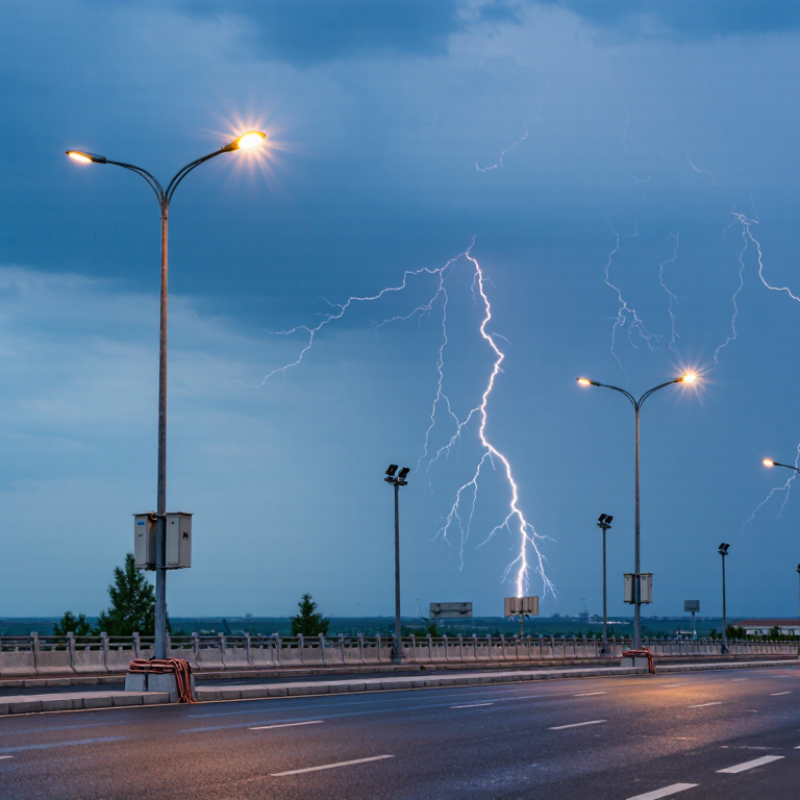
China Best LED Street Lights Lightning Surge Protection?

Lightning Risks and Surge Standards for China’s LED Street Lights

China’s LED street lights face repeated surge stress from nearby lightning, long pole cables, and switching events. A strike need not hit a luminaire directly. It can induce a sharp voltage rise along the feeder, damaging the driver, control unit, or insulation. The World Meteorological Organization describes lightning as a major weather hazard, while IEC 61000-4-5 defines surge-immunity testing using a 1.2/50 μs voltage waveform and an 8/20 μs current waveform. These are test conditions, not a promise of field survival. Details matter.

For projects in China, engineers should check the applicable GB/T 17626.5 surge-immunity requirements and select surge protective devices suited to the installation’s exposure and grounding arrangement. IEC 61643-11 provides reference requirements for low-voltage surge protective devices. In practice, a device’s rating alone is not enough: cable length, bonding, enclosure sealing, and the distance between the protector and LED driver affect protection. A wet pole base or loose earth connection can undermine an otherwise sound design. It is easy to overlook maintenance. Inspect connections after severe storms, and record failed drivers by location; recurring failures may point to a wiring or grounding weakness, rather than inadequate fixture power.

How 10/20 kV, 8/20 µs Tests Measure LED Surge Protection

A 10/20 kV surge test asks whether an LED street light can withstand a high-voltage impulse. The 8/20 µs label describes the surge-current waveform: it rises quickly, then decays. These figures are not interchangeable. The actual current through the luminaire depends on the test setup, including its generator and coupling network.

During a controlled test, technicians apply impulses between specified conductors, such as line and earth. They check the surge-protection device, driver, insulation, and light output. A unit may survive without catching fire yet still suffer flicker or reduced output. That matters. Test records should state the voltage, current, polarity, number of impulses, wiring mode, and whether the light remained operational. Without those details, a kV figure alone says little.

For a credible assessment, repeatable test conditions are essential. Field wiring, grounding, and nearby lightning paths can change what a fixture experiences. A laboratory result cannot predict every installation. Still, it offers useful evidence. The less tidy part: test reports can look precise while leaving important setup details unclear. Check those details before comparing products.

Choosing Type 1, Type 2, and Type 3 SPDs Under IEC 61643-11

China’s best LED street lights need surge protection matched to the installation, not just a high joule rating. Under IEC 61643-11, Type 1 SPDs are tested with a 10/350 μs current waveform and suit service entrances exposed to partial lightning currents. Type 2 devices use an 8/20 μs waveform and are commonly installed in distribution panels. Type 3 units provide fine protection near sensitive equipment, such as LED drivers, but should work with upstream protection. These waveform classifications come from IEC 61643-11; they describe standardized tests, not a guarantee of field performance.

For a pole-mounted luminaire, check the supply arrangement, earthing, exposure, and the driver’s stated surge withstand level. A panel-mounted Type 2 SPD may reduce incoming surges, while a coordinated Type 3 device near the driver can help limit residual voltage. Long cable runs and poor bonding can undermine that plan. The detail matters.

Tips: Compare the SPD’s Uc, Up, and discharge-current ratings with the system voltage and equipment limits. Check whether the stated protection applies in common-mode, differential-mode, or both. IEC test classes are useful, but real sites vary; that is easy to underestimate. Use the current standard edition and a qualified electrical designer for final selection.

Comparing 10–20 kA Inom and 20–40 kA Imax SPD Ratings

China’s best LED street light surge protection cannot be chosen by one number alone. Inom indicates the SPD’s nominal discharge current, commonly tested with an 8/20 μs waveform. A 10–20 kA Inom rating describes repeated operating capability under a specified test. Imax shows the highest discharge current the device can handle during testing. A 20–40 kA Imax rating may offer greater peak tolerance, but it does not automatically provide better field protection. Ratings need context.

For urban streets with overhead lines, exposed poles, and frequent storms, a 20 kA Inom device may provide a stronger working margin than a 10 kA unit. A 40 kA Imax rating can help during severe transient events, especially when grounding conditions are stable. Yet poor earthing can limit any SPD. Not always. Keep connection leads short, straight, and securely terminated. Check the protection level, voltage rating, backup protection, and operating temperature beside Inom and Imax.

During site inspections, technicians should measure earth resistance and examine damaged luminaires, rather than reading catalog figures alone. A coastal road may need different coordination from an inland residential avenue. This comparison is not always tidy. Higher Imax is useful, but mismatched protection levels can still expose LED drivers to destructive voltage. Review system voltage, pole wiring, lightning exposure, and replacement planning together. One rating never tells the whole story.

LED Street Light Surge Protection: Comparing Inom and Imax Ratings

The chart compares example SPD rating ranges: nominal discharge current (In) of 10–20 kA and maximum discharge current (Imax) of 20–40 kA. These are separate ratings, typically specified using an 8/20 μs current waveform; Imax describes a maximum discharge level and is not a substitute for In. Check the product datasheet and installation requirements when selecting an SPD.

Verifying IP66 Enclosures, Grounding, and SPD Service Life

China’s best LED street lights need more than a sealed housing. They need verified surge protection.

Vaisala’s 2023 Annual Lightning Report recorded more than eight billion detected lightning events worldwide. Local exposure still varies sharply. Coastal roads, open bridges, and highland areas deserve stricter testing. An IP66 enclosure, defined by IEC 60529, blocks dust and powerful water jets. It does not protect damaged gaskets or loose cable glands. Inspectors should check the door seal, breather, drain path, and connector torque. Small gaps invite condensation. That failure is easy to miss.

Grounding must create a short, low-impedance path. IEEE guidance emphasizes bonding exposed metalwork and avoiding long, sharp conductor bends. A dedicated earth connection is not automatically effective. Soil resistance, corrosion, and shared utility paths can change performance. IEC 61643-11 provides testing principles for low-voltage surge protective devices. Select an SPD with suitable maximum continuous operating voltage, discharge current, thermal protection, and a visible status indicator. Service life depends on repeated surge exposure, not calendar years. A unit may fail after one severe event or survive many smaller ones. Manufacturer claims need field verification. That part is often overlooked. One practical weakness remains: maintenance teams may replace the luminaire but ignore the SPD indicator, leaving a dark road and hidden vulnerability.

China Best LED Street Lights Lightning Surge Protection? - Verifying IP66 Enclosures, Grounding, and SPD Service Life

A practical, brand-neutral checklist for assessing outdoor LED street lights. Verify ratings and test reports against the exact luminaire configuration and the applicable project requirements.

Verification Area What to Check Evidence to Request How to Interpret It
Enclosure ingress protection Confirm the complete luminaire enclosure is rated IP66, including the assembled housing, seals, cable entries, and access covers. IP test report or certificate identifying the tested model, configuration, and applicable edition of IEC 60529 or the relevant national adoption, such as GB/T 4208. Under IEC 60529, the first digit 6 denotes dust-tight protection; the second digit 6 concerns protection against powerful water jets. IP66 does not, by itself, certify lightning or surge immunity.
Surge protective device (SPD) Check whether an SPD is included, its location in the circuit, rated operating voltage, protection level, discharge-current ratings, and coordination with the supply system. SPD datasheet, wiring diagram, product test documentation, and the luminaire’s stated surge test level. For applicable low-voltage SPDs, check relevant IEC 61643 series documentation. Do not compare a single surge-current figure in isolation. The suitable SPD type and ratings depend on the installation, exposure, earthing arrangement, and project design.
Surge test evidence Verify that surge-immunity testing covers the complete luminaire and the specified operating mode, not just a driver or SPD component. Test report stating the test method, waveform, test level, coupling mode, number of test applications, and pass/fail criteria. IEC 61000-4-5 is a common surge-immunity test method. Test results are meaningful only when the tested sample and configuration match the supplied product. A test level is not a guarantee against every direct or nearby lightning event.
Protective earthing and bonding For Class I equipment, inspect the protective-earth terminal, continuity of the earth path, bonding of accessible conductive parts, and the installation connection. Wiring diagram, protective-earth continuity test results, installation instructions, and inspection records for the installed circuit. Grounding quality depends on the full installation, including connections and bonding. There is no single earth-resistance value that is suitable for every site; follow local electrical rules and the project design.
Class II construction If the luminaire is marked Class II, verify the insulation design and approved product documentation; do not assume it needs a protective-earth conductor. Product marking, insulation-class documentation, construction details, and the manufacturer’s installation instructions. Class II equipment relies on double or reinforced insulation. Follow the product’s specified wiring method and applicable local requirements.
SPD status and service life Check whether the SPD has a visible status indicator, a replaceable module, or a remote status contact, and identify how failure is detected. SPD datasheet, replacement instructions, status-indicator description, and any stated inspection or maintenance guidance. SPD service life is not a universal fixed number of years. It varies with surge exposure, operating conditions, SPD design, and end-of-life criteria; follow the product guidance and inspect indicators as required.
Replacement and maintenance Confirm that a failed SPD can be safely identified and replaced, and that the luminaire can be isolated before servicing. Service instructions, compatible replacement specifications, isolation procedure, and maintenance schedule for the installation. Replace an SPD when its indicator or monitoring system signals end of life, or when inspection and testing show it is no longer serviceable. Use a compatible rated component.
Installation conditions Check cable entry sealing, cable-gland suitability, terminal tightness, conductor routing, and compliance with the specified mounting orientation. Installation manual, approved cable-entry details, commissioning checklist, and site inspection records. Incorrect installation can compromise enclosure protection and surge performance even when the product’s documented ratings are adequate.
Procurement acceptance Match the supplied model, driver, SPD, enclosure, and wiring diagram to the approved submittal and project specification. Model-specific datasheets, certificates or reports, nameplate photographs, bill of materials, and incoming inspection records. Accept evidence that is traceable to the exact product configuration. A generic certificate or report for a different model is not sufficient proof of the supplied unit’s performance.

FAQS

Can lightning damage a street light without hitting it directly?

Yes. A nearby strike can induce a voltage surge along feeder cables, damaging the driver, control unit, or insulation.

What do IEC 61000-4-5 surge tests show?

They use standardized voltage and current waveforms. Passing a test does not guarantee survival during every real storm.

How should Type 1, Type 2, and Type 3 surge protectors be used?

Type 1 suits service entrances exposed to partial lightning currents. Type 2 is commonly placed in distribution panels. Type 3 adds protection near sensitive equipment, such as an LED driver.

Is a high surge rating enough when choosing a protector?

No. Check system voltage, discharge-current ratings, protection level, grounding, and whether protection covers common-mode, differential-mode, or both.

What can weaken surge protection on a pole-mounted light?

Long cables, poor bonding, loose earth connections, and excess distance between the protector and driver can undermine protection.

Does an IP66 enclosure prevent every water-related problem?

No. It resists dust and powerful water jets, but damaged gaskets or loose cable glands can still let moisture in. Small gaps matter.

What should inspectors check after severe storms?

Check seals, cable glands, connector torque, grounding connections, and the protector’s status indicator. Record failed drivers by location.

How long does a surge protective device last?

There is no fixed service life. A severe surge may cause early failure, while repeated smaller events may also wear it down. Field checks are needed.

What might recurring driver failures reveal?

They may point to weak wiring or grounding rather than insufficient fixture power. That possibility is easy to miss.

Conclusion

Protecting LED street lights from lightning requires a coordinated approach that combines suitable surge protection devices, reliable grounding, and weather-resistant construction. How to protect LED street lamps from lightning surges? Start by evaluating local lightning exposure and selecting SPDs tested with 10/20 kV combination-wave conditions and 8/20 µs current impulses. These tests help indicate how effectively the protection can limit transient voltage and divert surge current away from LED drivers and control circuits.

Under IEC 61643-11, Type 1, Type 2, and Type 3 SPDs serve different protection levels, with Type 2 commonly used in distribution and lighting equipment and Type 3 providing additional protection near sensitive electronics. Comparing nominal discharge current ratings of 10–20 kA with maximum discharge current ratings of 20–40 kA helps match the SPD to expected surge intensity. Finally, IP66 enclosures, short and properly sized grounding paths, thermal disconnection, and replaceable modules can improve safety, durability, and service life in demanding outdoor environments.

Henry

Henry

Henry is a dedicated marketing professional with a profound expertise in the company's offerings. With years of experience in the industry, he possesses an impressive understanding of the market dynamics and consumer behaviors that drive success. Henry is committed to sharing his insights through......